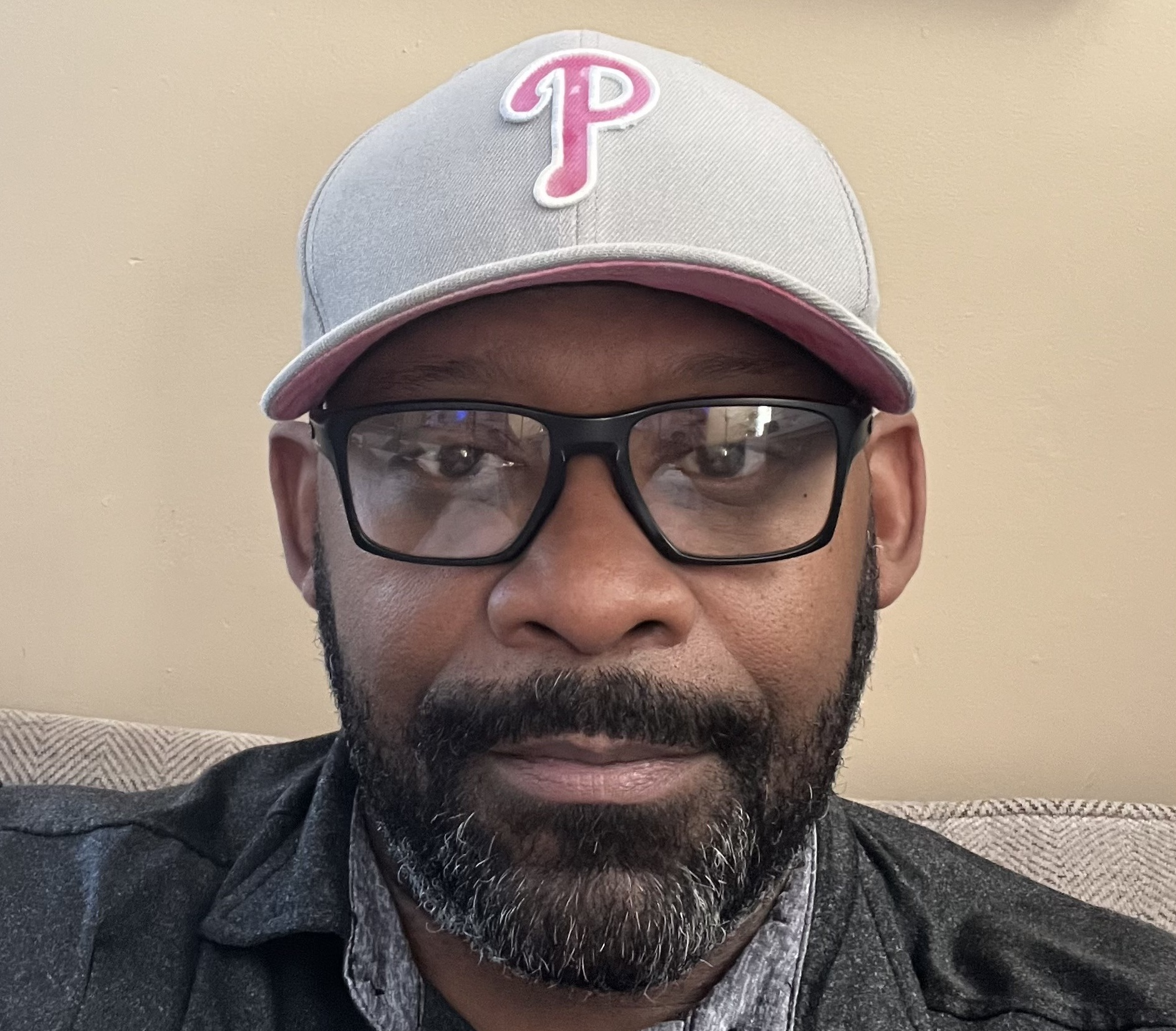
The bullet that went through Dennis Miller’s chest missed his heart by only two centimeters. He was in West Philadelphia, and it was Father’s Day. Thirty years later, the scar remains.
“I got shot just doing some stuff I had no business doing,” Dennis says. “I was being young.” In the years before the incident, he had been bouncing between different jobs while living in a small North Philadelphia apartment.
“I just kind of butted around and didn’t do anything.” While his peers had finished high school in 1990, he left during his junior year to start working full-time. “I kept not doing what it was that you would figure the next step would be.”
He was fortunate to recover, but he didn’t want to move back in with his family. It would be confining, and he couldn’t stand hanging around for much longer. “So I got all my money together and got on the bus south until my money ran out.”
He was hoping to ride it down to New Orleans but ran out of money in Raleigh, North Carolina. He neither knew anyone there nor was he familiar with the area. “I just walked off the bus and figured I would figure it out.”
Figuring things out was harder than he expected. “I was homeless for that whole year. I lived in the back of a box truck. I lived on people’s couches,” he says. He also spent some time at “The Ark,” one of Raleigh’s homeless shelters.
Dennis’s family knew his situation was difficult, but they didn’t know the extent of it. “If you want to come home, you can stay with us,” they said to him. Dennis shrugged it off, telling them that he was with friends and working a couple of jobs.
His grandmother, though, wasn’t buying it. “I hear what you’re saying,” she told him. “I know that you’re struggling, but I’m just tired of this being what’s going on with you. So figure it out. Do something.”
Since he was a kid, she spoke to him like an adult. There was no “baby talk” when he was younger, and it ran through the family. “My whole life, I never knew about Santa Claus,” Dennis says.
She owned a laundromat in South Philadelphia, where he stayed after school every day until he was a teenager. “She loved having us there. When we would come in the door, she’d be sitting in the back of the place looking at the front door, waiting for us to come in.” After finishing homework, Dennis and his brothers had chores ranging from bookkeeping the day’s sales to taking the back off toilets for plumbing fixes.
“She was the commanding officer. Her children were her lieutenants and below her. She really ran everything like a military operation,” Dennis says.
That might have been because his grandmother served during World War II. Her name was Sylvia Benton, and she enlisted in the 6888th Central Postal Directory Battalion. It was the only all-female, all-black battalion to serve in a combat zone during the war.
So when Dennis was on the phone with his grandmother, living off the streets of Raleigh and thinking about what he could do, her suggestion was simple: “If I was you, I’d go into the military.” She talked about how it changed her life and helped her escape the poverty trap.
The effect wasn’t immediate. “I listened, but I wasn’t really moved by it,” Dennis says. Part of it was because it wasn’t something different. All of Sylvia Benton’s sons and grandsons served in the Army. “I didn’t want to get into the family business. I wanted to strike out and do my own thing.”
That mindset changed not long after, when something out of the blue caught his eye. He was going down the mall escalator, having just finished his first eight-hour shift at the Banana Republic upstairs. With nothing better to do, he worked a second eight-hour shift at the Champs Sports below and headed down to start the job.
“As I’m looking down the escalator,” he says, “there were two Marine Corps recruiters coming this way.” They were making their way up, in dress blues and ribbons all over. “When I saw them, they just looked like there was a spotlight on them. Music.”
“I looked at the more senior man, and I was just like, ‘What are you doing, bro? Tell me what’s going on,’” he says. “So he’s like, ‘Come to the top, and I’ll fill you all in.’” When Dennis got to the bottom of the escalator, he went right back up. “Probably less than a month later, I was enlisted and on my way to Parris Island.”
He chose to be in the Marines because of the lifestyle and the challenge. It was an alluring ethos to both him and the others in boot camp. That said, their perceptions of protecting against the bad guys and coming in as heroes quickly dissipated.
“Boot camp was cleaning the bathrooms and doing what that guy told you to do.” A sense of service, though, took center stage. “It was all really learning how to be selfless and do for the good of the group. And doing for the good of the group meant doing for the good of the base.”

Thirteen years went by quickly for the young infantryman, with seven deployments abroad. It was his first time outside the country. And throughout his tours, a sense of duty remained the guiding light. “I learned how to lead the way that the Marine Corps tells you to, from boot camp all the way up.”
It was also while serving in the Marines that he became a political independent. “That’s where I crystallized my lack of affiliation with political parties.” Back home, political changes were stirring. “My first commander-in-chief was Clinton, then it was Bush, then Obama. And all three men had wildly different ways to run the joint.”
Yet partisanship and politics were never part of the call of duty. “One of the main things drilled into our heads was that our political leanings had no place in our day-to-day work in the Marine Corps.” It wasn’t his job to think about the politicians. “It was my job to get the work done that they gave us. Worrying about politics and whether you liked this guy and voted for him was all unimportant to any of my superiors.”
That mentality stuck for years after his service. “The power of personality and all of those things about the office really became unimportant to me.” He was interested in the practical details: “What was this person doing? How much of the job was getting done? How much were they standing around posturing and talking and whatever else it was, as opposed to being in the office working every day?”
Substance over performance continues to inform how he votes. “I think that the business of politics over the past twenty years has become so divisive and unregulated that it doesn’t resemble anything that I can think of,” he says. He’s concerned about Americans fighting with each other rather than seeing what really matters. “I’m really confused by the way that the political landscape looks and how it doesn’t serve the work that’s supposed to be done.”
He thinks we will get through it all, and it’ll begin with ordinary Americans. “I’m optimistic that the people of America are smarter than they’re given credit for and are able to impact and make change.” It’s their lived experiences, of struggles to make ends meet and triumphs from serendipity, that are enough to make a difference.
“More and more, people are becoming disillusioned with the way that politics is becoming so polarized,” he says. “So the powers that be are going to be forced to listen to people who they may not have otherwise because more and more of us are becoming those people.”